


How many plastic bottles have you used today? From the water bottle rattling around in your gym bag to the fizzy drink we grab at lunch, plastic bottles have become such a normal part of everyday life that most of us barely notice them anymore.
In the UK alone, we use around 13 billion plastic bottles every year. Globally, more than one million plastic bottles are sold every single minute. And while the plastic used to make most drinks bottles (PET) is actually one of the easiest plastics to recycle, huge numbers still end up in general waste bins or the environment.

Most people aren’t careless on purpose. We recycle when we remember, try to make good choices, and feel slightly guilty when a bottle ends up in the wrong bin. But plastic bottles are surprisingly easy to lose track of. They get left in cars, dropped on school runs, tossed into general waste bins, or forgotten in parks and public spaces. Once they escape into the environment, they can stick around for 450 years or more. Over time, they break down into tiny particles known as microplastics, which can end up in rivers, soil, food chains, and eventually the ocean.
Thankfully, it’s not all bad news. When plastic bottles are collected and recycled properly, they can be turned into new bottles, clothing fibres, insulation, playground equipment, and even outdoor furniture. In other words, a bottle doesn’t have to become waste at all.
In this guide, we’ll look at what happens to plastic bottles after we throw them away, why some are easier to recycle than others, and how better recycling systems at home, work, schools, and public spaces can make a real difference.
Quick Navigation
- The problem with Plastic Bottle Waste
- Types of Plastic Bottles
- Plastic Bottles vs Soft Plastics
- How Plastic Bottles Are Recycled
- What Recycled Plastic Bottles Become
- How Plastic Bottle Collection Works Around the World
- The Best Ways to Collect Plastic Bottles
- The Future of Plastic Bottles
Plastic Bottle Waste: The Big Picture
The UK currently recycles only around 58% of the plastic bottles it uses. That means billions still end up in general waste, landfill, litter, rivers, and the ocean every year. Once plastic bottles enter the environment, they don’t just disappear.
According to the Ocean Conservancy, plastic bottles are among the most common items collected during global beach and ocean clean-ups. Over time, they break down into smaller and smaller pieces known as microplastics rather than properly decomposing.
Researchers have now detected microplastics in the air we breathe, the food we eat, and even inside the human body. Studies have found them in seafood, drinking water, blood, lungs, and placentas. Scientists are still working to fully understand the long-term impact, but it’s clear that plastic pollution doesn’t just go away.
The encouraging part is that plastic bottles are also one of the more recyclable types of plastic we use every day. Unlike soft plastics and films, PET drinks bottles are valuable, widely recyclable, and in high demand. When they’re collected properly, they can even be recycled back into food-grade packaging.
That’s why so many countries are investing in better bottle collection systems, from deposit return schemes to reverse vending machines. It’s also why businesses, schools, leisure venues, and public spaces are paying closer attention to how their recycling bins are designed and where they’re located. Recycling behaviour is often less about intention and more about convenience. The easier it is to recycle a bottle, the more likely people are to do it.
Before looking at how collection systems are improving, it helps to understand what plastic bottles are actually made from, and why some plastics are far easier to recycle than others.
Types of Plastic Bottles (and What Those Numbers Actually Mean)
Turn a plastic bottle over and you’ll usually spot a small triangle with a number inside it. Many people assume this is a recycling symbol, but it’s actually something called a resin identification code. The number tells recycling facilities what type of plastic the item is made from, helping them sort and process materials correctly.
Some plastics are highly recyclable and easy to turn into new packaging. Others are much harder to process and are more likely to be rejected or downcycled into lower-quality products.
PET (1): The Classic Drinks Bottle
PET is the plastic used for most drinks bottles and is one of the most widely recycled plastics in the UK.
You’ll commonly find it in:
- Water bottles
- Fizzy drinks bottles
- Juice bottles
- Sports drink bottles
Because PET is lightweight, valuable, and relatively easy to process, it can often be recycled back into food-grade packaging and new drinks bottles.
HDPE (2): The Tougher Everyday Plastic
HDPE is thicker, sturdier, and usually more opaque than PET.
- It’s commonly used for:
- Milk bottles
- Shampoo bottles
- Cleaning product bottles
HDPE is also widely recyclable, although it’s more often turned into products such as pipes, storage crates, wheelie bins, and outdoor furniture rather than new food packaging.
PP (5): The Plastic Used for Caps and Lids
Polypropylene (PP) is commonly used for bottle caps, flip-top lids, and some food containers. In the past, many people removed bottle caps before recycling. But in the UK, “caps on” recycling is now widely encouraged because modern recycling facilities can separate the materials during processing. Keeping lids attached also helps prevent small plastic caps becoming litter or escaping into waterways.
Multilayer and Coloured Plastics: The More Difficult Ones
Some plastic bottles are made using multiple layers of material to improve shelf life, while others use very dark colours for branding purposes. These are much harder to recycle effectively.
Mixed materials can be difficult to separate, and dark plastics are sometimes missed by optical sorting machines used in recycling facilities. As a result, these bottles are more likely to be rejected or downcycled into lower-value products.
Why Bottle Types Matter
Understanding the different types of plastic helps explain why recycling rates vary so much. PET and HDPE are valuable, widely accepted, and relatively straightforward to recycle. Other plastics need more sorting, more specialist processing, or more advanced recycling technology which makes them harder and more expensive to recycle on a larger scale.
Plastic Bottles vs Soft Plastics: Why They’re Treated Differently
Have you ever stood in front of a recycling bin wondering whether a crinkly wrapper belongs in the same place as a drinks bottle? You’re definitely not alone. One of the biggest causes of recycling confusion is that we tend to talk about “plastic” as though it’s one single material. In reality, plastic bottles and soft plastics behave very differently once they enter the recycling system.
Understanding the difference can make recycling much easier, whether you’re at home, at work, or using public recycling bins.
Plastic Bottles: The Easier Ones to Recycle
Most drinks bottles are made from rigid plastics such as PET (1) and HDPE (2). These plastics are widely recycled because they’re pretty simple for recycling facilities to process. They hold their shape well, which makes them easy for sorting machines to identify, and they’re usually made from a single type of plastic rather than multiple layers fused together.
They’re also valuable materials. Recyclers actively want PET and HDPE because there’s strong demand for recycled plastic that can be turned into new packaging and products.
Soft Plastics: Much More Complicated
Soft plastics are the flexible materials that bend, scrunch, or tear easily, including:
- Crisp packets
- Bread bags
- Film lids
- Carrier bags
- Wrappers and pouches
These materials are much harder to recycle effectively. That’s because many soft plastics are made from several layers of different materials bonded together, which makes separation difficult. Thin plastic films can also jam recycling machinery, while lightweight packaging tends to blow around sorting facilities and contaminate other recycling streams.
Even when soft plastics are technically recyclable, the infrastructure needed to process them is still inconsistent across the UK. That’s why many supermarkets now offer separate collection points for plastic bags and wrapping. Keeping soft plastics out of household recycling helps prevent contamination and gives the material a better chance of being recycled properly.
Why This Difference Matters
Plastic bottles aren’t perfect, but they’re one of the few plastic products with a well-established recycling system already in place. That’s why improving bottle collection through clearer signage, better bin placement, and more consistent recycling habits can make such a noticeable difference to overall recycling rates.
How Plastic Bottles Are Recycled
Putting a plastic bottle in the recycling bin is only the beginning of the story. Behind the scenes, that bottle goes through a surprisingly technical process designed to turn used plastic into clean, high-quality material that can be used all over again. Here’s what happens after you throw it away.
1. Collection: Getting Bottles Into the Right Bin
Every recycled bottle starts with collection, whether that’s through household recycling, workplace bins, school recycling stations, or public recycling points. This stage matters more than most people realise.
A bottle placed in the correct recycling bin has a good chance of staying in the recycling loop. A bottle thrown into general waste is usually lost to landfill or incineration, and bottles dropped as litter can easily end up in rivers and waterways.
That’s why clearly labelled, well-placed recycling bins make such a difference. Recycling behaviour is often driven by convenience.
2. Sorting: Separating the Materials
Once collected, bottles are taken to a Materials Recovery Facility (MRF), where large machines sort recyclables into different material streams. Conveyor belts, rotating screens, air jets, magnets, and optical scanners work together to separate plastics from paper, cans, cardboard, and glass.
PET and HDPE bottles are also separated from each other because they melt differently and are recycled into different products.
At this stage, soft plastics, food contamination, and non-recyclable items are removed to create cleaner batches of material.
3. Shredding and Washing
The sorted bottles are then chopped into small plastic flakes. Labels, glue, dirt, leftover liquid, and residues from drinks are washed away using hot water and detergents. This cleaning stage is really important because even small amounts of contamination can reduce the quality of recycled plastic.
This is the point where the bottle stops being a bottle and becomes raw material again.
4. Separation and Quality Control
The plastic flakes go through additional cleaning and separation processes to remove any remaining impurities. Different plastics behave differently in water, which helps recycling facilities separate materials more accurately. PET, for example, sinks, while HDPE floats.
The cleaner the material, the more likely it can be turned back into high-quality products, including food-grade packaging.
5. Pelletising: Turning Plastic Into Raw Material
Once cleaned, the plastic is melted and formed into tiny pellets known as rPET or recycled HDPE granules. These pellets are the building blocks manufacturers use to create new products, and they’re in high demand as businesses try to reduce their reliance on virgin plastic. Pellets are also easier to transport, store, and manufacture with than loose flakes.
6. Manufacturing: Giving Bottles a Second Life
Finally, the recycled pellets are melted down again and turned into new products. PET is commonly used to make new drinks bottles, food packaging, carpets, clothing fibres, and insulation materials. HDPE often becomes milk bottles, pipes, playground equipment, benches, and outdoor products. In many cases, the next bottle you buy may already contain recycled material from a previous one.

What Recycled Plastic Bottles Become
Once a plastic bottle has been recycled, it’s no longer waste, it becomes a valuable raw material that can be turned into all sorts of new products. Some of those uses are familiar. Others are surprisingly creative.
New Bottles
One of the best outcomes for a recycled PET bottle is becoming another bottle. This is known as closed-loop recycling because the material stays within the same recycling cycle instead of being downgraded into lower-quality products.
Many major brands are now increasing the amount of recycled PET (rPET) used in their packaging, partly because of new regulations and partly because customers expect it.
Clear PET is especially valuable because it’s easier to recycle back into food-grade packaging, which is why many companies are moving away from coloured plastics.
Every bottle successfully recycled into a new one helps reduce the demand for virgin plastic.
- Clothing and Textiles
- Recycled bottles are also widely used to make polyester fibres for:
- Fleece jackets
- Sportswear
- Carpets
- Bedding
- Reusable shopping bags
In fact, a single T-shirt can contain the equivalent of around 10–12 recycled plastic bottles! It’s not a perfect solution, though. Synthetic fabrics can release tiny microfibres during washing, which may eventually enter waterways and oceans.
- Food Packaging and Containers
- Recycled PET is commonly used in products such as:
- Fruit punnets
- Salad containers
- Bakery trays
- Cosmetic packaging
These products don’t always require the same ultra-high-grade material needed for drinks bottles, which gives slightly lower-grade recycled plastic a useful second life.
Outdoor Products and Street Furniture
HDPE, the tougher plastic used in milk bottles and detergent containers, is often turned into durable outdoor products including:
- Playground equipment
- Park benches
- Garden furniture
- Traffic bollards
- Outdoor recycling bins
Because HDPE is weather-resistant and hard-wearing, it works especially well for products designed to stay outdoors for years.
Many modern outdoor recycling bins are now made using recycled plastics themselves, helping close the loop even further.
Construction Materials
Recycled plastics are increasingly being used in long-life construction products such as:
- Composite decking
- Insulation materials
- Drainage pipes
- Roofing membranes
Using recycled plastic in construction helps keep materials in use for decades rather than allowing them to become waste after a single use.
The More Surprising Second Lives of Plastic Bottles
Plastic bottles don’t just become packaging and textiles. Around the world, designers, engineers, and community groups are finding increasingly creative ways to reuse recycled plastic.
Roads Made With Recycled Plastic
Some companies now mix recycled plastics into asphalt to help create stronger, more durable road surfaces. The recycled material replaces part of the oil-based bitumen traditionally used in road construction, helping reduce fossil fuel use while also improving resistance to cracking and potholes.
Eco-Bricks and Community Projects
Eco-bricks are plastic bottles tightly packed with non-recyclable plastic waste to create sturdy building blocks. They’ve been used in community projects to make benches, planters, garden walls, and small outdoor structures, particularly in areas where formal recycling systems are limited.
Art Installations Built From Plastic Waste
Artists around the world have used discarded bottles to create large-scale sculptures and public art installations, often using plastic collected from beaches and waterways. These projects work as both beautiful artworks to look at and visual reminders of just how much plastic we use every day.
Shoes and Sportswear
Many sports and fashion brands like Adidas use recycled polyester made from plastic bottles in trainers, activewear, swimwear, and outdoor clothing. Because recycled polyester performs similarly to virgin polyester, it’s become a popular material for lightweight, moisture-wicking fabrics. So yes, your gym kit may genuinely have started life as a drinks bottle.
How Plastic Bottle Collection Works Around the World
If you’ve ever wondered why some countries seem to recycle bottles effortlessly while others struggle, the answer usually comes down to one thing: convenience.
Around the world, different countries collect, sort, and reward recycling in very different ways, and the results tell us a lot about what actually works.
Countries That Pay People to Recycle
In countries like Germany, Norway, and Sweden, recycling a bottle feels less like a chore and more like a quick win for both your wallet and the environment.
Germany introduced its modern deposit return scheme in 2003, building on successful Nordic models already proving how effective small incentives can be. Today, most drinks bottles carry a refundable deposit of around €0.25, which shoppers get back when they return the container. That small incentive has had a huge impact. Germany now achieves bottle return rates of around 98%. When recycling is easy, visible, and rewarding, people participate.
Reverse Vending Machines: Making Recycling Feel Effortless
Across much of Europe, bottles are returned through reverse vending machines, automated collection points that scan and sort containers before refunding the deposit.
Denmark’s national “Pant” system is one of the best-known examples. Reverse vending machines can be found in 3000 supermarkets, convenience stores, and transport hubs across the country, making bottle returns part of everyday life rather than an extra chore. And they’re oddly satisfying to use, you just insert a bottle, hear the clunk, and get your refund. Simple.
The result is a recycling system that feels quick and easy for the public while also helping governments and businesses keep valuable material in the recycling loop.
Countries That Rely on Kerbside Recycling
In countries like France and much of North America, recycling mostly happens through kerbside collections. It’s convenient in theory, but it also relies heavily on people remembering what goes where, and that’s where things get inconsistent.
France expanded household recycling rules in 2023 so that all plastic packaging could be recycled at home, but recycling rates still lag behind countries with deposit return systems in place at only roughly 27%.
Across the Atlantic, the picture is similar. Most Americans (77%) say they recycle regularly, yet national recycling rates remain much lower than many people assume at around 32%. The problem usually isn’t laziness. It’s confusion. When bins look similar, signage is unclear, or recycling rules vary from place to place, even well-meaning people get it wrong.
Countries Supported by Informal Waste Collectors
In some parts of the world, recycling depends heavily on informal waste collectors rather than formal council systems. India, for example, recycles a remarkably high percentage (80%+) of its PET bottles thanks largely to informal collectors known as Kabadiwalas, who collect, sort, and sell recyclable materials. Brazil has a similar network of waste-picker cooperatives called catadores, who play a major role in recovering valuable materials that might otherwise end up as litter or landfill.
The Best Ways to Collect Plastic Bottles at Home, Work, and In Public Spaces
At Home: Make Recycling Easy to Reach
Most people want to recycle. They just don’t want to overthink it. That’s why bin placement matters more than people realise. A recycling bin hidden away in a cupboard is easy to ignore, while one placed near where bottles are actually used tends to become part of the routine automatically.
Clear labels, simple colours, and bottle-specific graphics can also make recycling feel more intuitive, especially for children.
And while bottles should be empty before recycling, there’s no need to scrub them spotless. A quick rinse is usually enough. Keeping caps attached is encouraged too, as it helps prevent small plastic pieces becoming litter.
A dedicated bottle recycling bin can work particularly well in kitchens, garages, and utility rooms because it removes any uncertainty about what belongs inside.
At Work: Convenience Beats Good Intentions
In workplaces, people are usually busy, distracted, and making quick decisions. That means recycling only works when it’s the easiest option available.
Bins placed beside general waste bins consistently collect more recyclables than standalone recycling bins. Location matters too. Recycling stations near kitchens, entrances, meeting rooms, and communal areas naturally see higher use.
Design also plays a role. Clean, clearly labelled bins help reinforce recycling as part of the workplace culture rather than an afterthought.
For offices and shared spaces, multi-stream recycling stations can make sorting quick and intuitive while helping reduce contamination.

Product Shown: Executive Office Recycling Bin
In Schools: Design That Encourages Participation
Schools are busy environments, so recycling systems need to be simple, visual, and easy to use. Younger children tend to respond well to novelty bins, while older pupils usually engage better with cleaner, more modern-looking bins and straightforward signage. The goal isn’t perfection. It’s creating a system that makes the right choice feel easy.
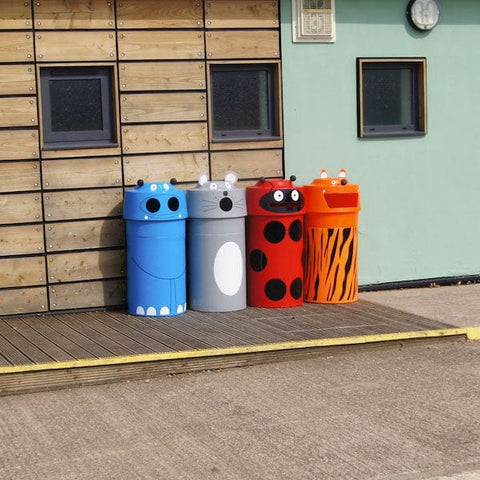
Product Shown: Novelty Animal Recycling Bins
In Public Spaces: Visibility Is Everything
In parks, transport hubs, shopping areas, and leisure venues, people are constantly on the move. They’re unlikely to search for a recycling bin, which means placement becomes much more important. Bins positioned near entrances, exits, seating areas, and food outlets are far more likely to capture bottles before they become litter.
Bright colours, bottle-shaped openings, and durable outdoor materials can also help bins stand out in busy environments. Outdoor recycling bins need to work hard, they have to be visible, weather-resistant, and robust enough to handle heavy daily use.
Events and Venues: Capture Bottles at the Point of Use
Festivals, sports venues, and public events can generate huge volumes of plastic bottles in a very short space of time.
The most effective setups make recycling obvious at the exact moment people finish their drink. Clusters of matching bins usually perform better than isolated bins because they reduce hesitation and help people quickly identify the correct option. Large capacity plastic bottle bins also help prevent overflow, which can quickly discourage people from recycling properly.
The Future of Plastic Bottles: What Comes Next?
Plastic bottles aren’t disappearing any time soon, but the way they’re designed, collected, and recycled is changing quickly.
Governments, manufacturers, and recycling companies are all under pressure to reduce waste, increase recycled content, and make packaging easier to recycle in the first place.
More Recycled Content, Less Virgin Plastic
The UK’s Plastic Packaging Tax, introduced in 2022, charges manufacturers for packaging that contains less than 30% recycled plastic.
The goal is simple: make recycled plastic more valuable and encourage businesses to use less virgin material. As a result, demand for high-quality recycled PET has increased significantly, pushing brands to rethink how bottles are designed and collected.
A Deposit Return Scheme In The UK
We’ve had a long journey to get here, but there’s finally a clear picture of where things stand with the UK’s Deposit Return Scheme. In April 2024, the UK Government confirmed that a UK‑wide scheme won’t launch before October 2027. The latest government update shows that England, Scotland, and Northern Ireland are now agreed on that date, with Wales signalling it may follow the same timeline. The scheme will cover PET plastic bottles and metal cans between 150ml and 3L, though glass remains a point of disagreement. England and Northern Ireland plan to exclude it, while Wales still wants it in. When it finally arrives, shoppers will pay a small deposit, expected to be 20–25p, which they get back when they return the container.
Why does this matter? Countries with deposit return systems have already shown how effective they can be. Germany routinely hits 98% return rates, Norway sits around 92%, and both have cleaner streets and a steady supply of high‑quality recycled plastic. If the UK follows the same path, the impact on litter and recycling could be huge.
Smarter Bottle Design: Easier to Recycle by Design
If you look at a plastic bottle today and compare it with one from 20 years ago, you probably wouldn’t notice much difference, but recyclers absolutely would. Many of the biggest changes to plastic bottles have been happening behind the scenes. Manufacturers are redesigning bottles to make them easier to sort, clean, and recycle, often in ways most people would never notice.
Clear PET has the highest resale value and can be recycled back into food‑grade plastic again and again, which is why brands are phasing out coloured PET entirely. Coca‑Cola, for example, scrapped its iconic green Sprite bottles in 2022 so they could be recycled more easily into new bottles. Labels are shrinking or switching to “wash‑off” adhesives, which means they slide off cleanly during processing instead of contaminating the plastic. And one thing you will have noticed is that bottle caps are now designed to stay attached. The EU made tethered bottle caps mandatory in July 2024, and UK manufacturers are following suit because attached caps are far less likely to become litter and far more likely to be recycled.
Even the bottles themselves are slimming down. The average PET bottle in Europe is now up to 50% lighter than it was 30 years ago, thanks to clever engineering that uses less plastic without compromising strength.
Bioplastics and Plant‑Based Bottles
Bioplastics are having a moment, and it’s easy to see why people might hail them as the solution to the plastic problem. Take Coca‑Cola’s PlantBottle, for example, the world’s first fully recyclable PET plastic bottle made partially from sugar canes and other plants, which the company introduced in 2009. It’s been used in more than 35 billion bottles worldwide and has achieved a huge reduction in carbon emissions. So far, so good. However, not all bioplastics fit neatly into our current recycling infrastructure. Compostable plastics cannot go into kerbside recycling and testing has shown that many only break down in industrial composting facilities, which the UK has limited capacity for. This includes 60% of plastics marked ‘home compostable.’ So yes, bioplastics are promising, but only if we develop the infrastructure for them.
AI‑Driven Sorting and Smart Recycling Facilities
Modern recycling facilities are increasingly using AI, robotics, and advanced optical scanners to improve sorting accuracy. Machine learning systems can now identify plastics by colour, shape, size, and material type far more quickly than manual sorting alone. This helps recycling centres recover more usable material while reducing contamination.
As the technology improves, recycling facilities are becoming faster, more accurate, and more efficient at keeping valuable plastic in circulation.
Small Habits, Real Impact
It’s easy to look at the scale of plastic waste and assume individual actions don’t matter. But recycling works because of thousands of small decisions repeated every day, at home, at work, in schools, and in public spaces.
A bottle placed in the right bin is a bottle that stays in the recycling loop instead of becoming litter or landfill. And while no recycling system is perfect, the most effective ones all have one thing in common: they make the right choice feel easy.
That’s why details like clear signage, sensible bin placement, and easy-to-understand recycling systems matter more than people often realise. When recycling fits naturally into everyday life, more people will do it.
Whether you’re improving recycling at home, managing waste in a workplace, or planning facilities for a school, venue, or public space, small changes can have a big impact over time.
If you’re unsure whether your current setup is working as well as it could, whether bins are in the right places, clearly labelled, or being used properly, it’s always worth reviewing the system as a whole. Sometimes, the smallest changes are the ones that make recycling finally click.


